First: use the address shown in the deposit screen
When you open the deposit screen and choose a network, Cadmos shows an address for that specific route:
- Arbitrum: Cadmos shows your wallet address. Funds sent there arrive directly in your Cadmos smart account.
- Other supported EVM networks: Cadmos shows a network-specific bridge address. Funds sent there follow the supported bridge route to your Cadmos balance on Arbitrum.
These addresses serve different purposes. The bridge address shown for Polygon, for example, is not your Cadmos wallet address on Polygon.
When cross-chain recovery is needed
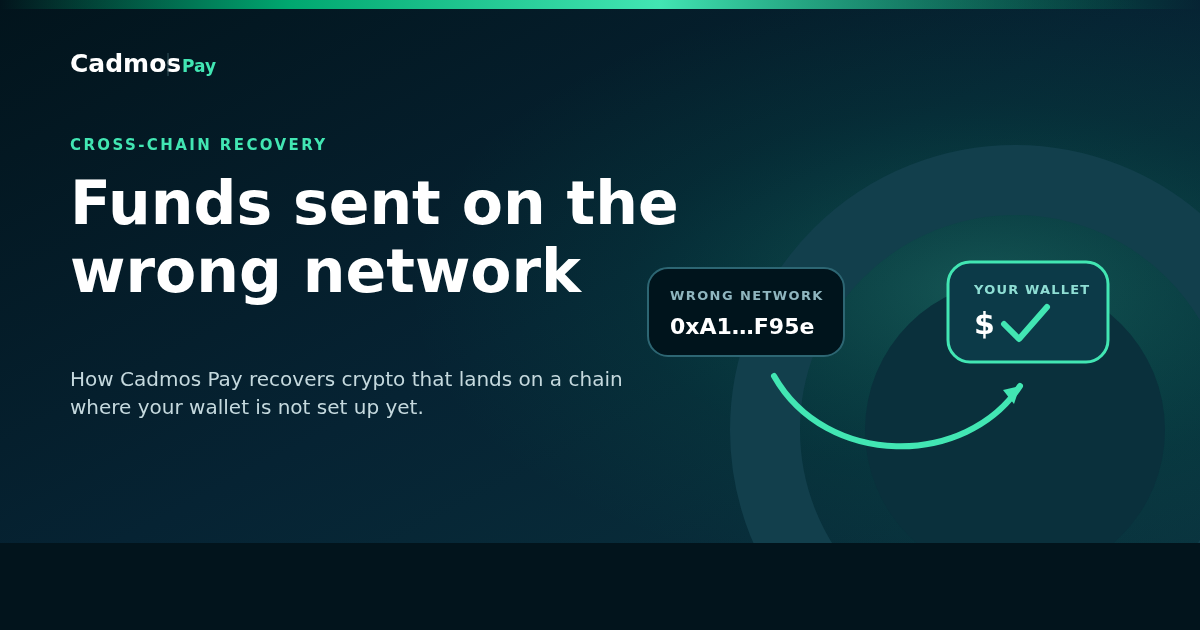
Recovery is for a different situation: someone sends funds directly to your Cadmos wallet address on another EVM network instead of using the bridge address shown by Cadmos.
For example, a sender may copy your Arbitrum wallet address, select Polygon in their own wallet, and send USDC to that same address on Polygon. The transfer bypasses the Polygon bridge address from the Cadmos deposit flow. Polygon records the USDC balance at the wallet address, but the funds do not bridge to Arbitrum and do not appear in your normal Cadmos balance.
Cadmos calls this a misdeposit. It is not a normal cross-chain deposit, and changing networks in the deposit screen would have shown a different address designed for that route.
This standard recovery path applies only when funds were sent directly to the precomputed Cadmos smart-account address. A transfer to a different Cadmos-controlled protocol or smart-contract address is an exceptional case. It may require chain-specific deployment reconstruction or other bespoke infrastructure, may take substantially longer, and may not be recoverable. Cadmos assesses these cases individually before confirming whether recovery is possible.
Why the funds cannot move yet
Your Cadmos wallet is a smart account deployed on Arbitrum. Cadmos uses an EVM feature called CREATE2, which can calculate where the matching smart account would be deployed on another supported EVM network.
That precomputed smart-account address may have the same characters as your Arbitrum wallet address, but each blockchain has separate state. If the smart-account contract has not been deployed at that address on Polygon, there is no account code there to authorize an outgoing transfer.
The balance is therefore recorded at the precomputed address on Polygon, but it is stranded outside the normal deposit and bridge flow. Recovery deploys the missing smart account so the funds can be moved.
How Cadmos recovers the funds
Recovery makes that stranded balance transferable. It does not replace the bridge addresses shown in the deposit screen or change how future deposits should be made.
- A Cadmos operator verifies the recovery request, the wallet owner, and the destination for the recovered funds.
- The recovery system deploys the matching smart account on the network where the funds arrived. CREATE2 places it at the precomputed smart-account address that received the funds.
- The newly deployed account transfers the recoverable balance, minus the recovery fee.
- USDC and USDT are bridged back to your Cadmos wallet on Arbitrum. Other supported assets are sent to an address you provide.
The process is handled manually because deploying the correct account and choosing the correct destination are sensitive operations. Recovery is limited to the stranded funds being recovered; it does not give Cadmos access to your everyday wallet keys or Arbitrum balance.
After recovery, continue using the network-specific address shown in the Cadmos deposit screen for new deposits.
What Cadmos can recover
Cadmos currently supports standard wallet-address recovery from Ethereum, Optimism, Polygon, Base, and BNB Smart Chain. Where the funds go depends on the asset:
- USDC and USDT are bridged automatically back to your Cadmos wallet on Arbitrum. You do not need to do anything or supply an address.
- ETH, POL, BNB, and other tokens are sent to an address you provide, because there is no automatic route home for them.
Recovery is not available for:
- Funds sent on networks Cadmos does not support.
- Funds sent on non-EVM networks such as Bitcoin, where the CREATE2 address model does not apply.
- Amounts below $1, because the network cost would consume the balance.
Other tokens may require manual review. Cadmos will confirm whether the token can be transferred safely and may ask you for a destination address.
What it costs
The published fee schedule below applies to the standard wallet-address misdeposit recovery described in this guide. The fee covers contract deployment, network gas, and manual review. It is deducted from the recovered balance, so you do not need to pay it in advance. No fee is charged if the recovery does not succeed.
| Amount recovered (USD) | Fee |
|---|---|
| Less than $1 | Not recovered |
| $1 to $20 | $1 |
| Over $20 to $100 | $5 |
| Over $100 to $500 | $15 |
| Over $500 to $2,000 | $30 |
| Over $2,000 | 1.5%, capped at $100 |
For example, recovering $100 costs $5, so you receive $95. Recovering $515 costs $30, so you receive $485. The fee never exceeds $100. For assets such as ETH, POL, and BNB, Cadmos converts the dollar fee at the market rate used for the recovery quote.
If an exceptional protocol or smart-contract address recovery is technically possible, Cadmos may quote a different fee because the work can require bespoke deployment reconstruction, transaction sequencing, governance actions, and additional verification. Any different fee is disclosed for your acceptance before work begins and is never added retroactively. If you do not accept the quote, Cadmos does not proceed.