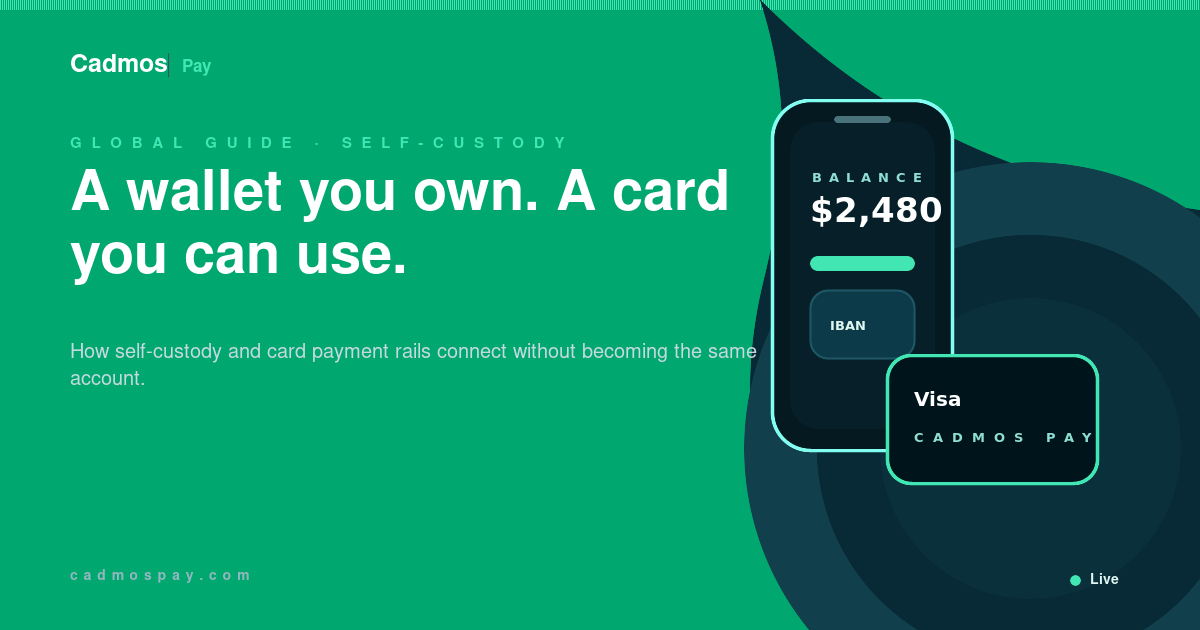
A wallet and card can appear in one app and keep separate balance records. The user's signing authority controls the on-chain wallet. A partner program issues and operates the card credential.
This separation governs merchant access and card authorisation. Refunds remain within the card program.
Wallet balance and card balance
Suppose the wallet holds 5,000 USDC and the user funds a card with $80. The wallet retains the remaining assets. The funded amount enters the card program after the quoted fees and conversion.
| Dimension | Self-custodial wallet | Partner card program |
|---|---|---|
| Value record | On supported blockchain networks at the wallet account | In the program's card balance and processing records |
| Movement authorisation | The user authorises an on-chain action | The issuer authorises or declines card requests |
| Payment identifier | Asset, network, address, and transaction data | Card credential, merchant, amount, and transaction data |
| Governing rules | Wallet signing logic, asset contract, and network rules | Issuer, processor, network, merchant, eligibility, and compliance rules |
| Recourse | Confirmed transfers are generally final; recovery can be limited | Refunds and disputes follow the card terms |
The issuer can reach the funded card amount. A deliberate funding action moves that chosen amount across the boundary.
What entirely self-custodial means
The blockchain records the assets; the phone provides an interface to the account. Ethereum's account documentation distinguishes externally owned accounts, controlled by private keys, from contract accounts, controlled by code. Cadmos uses a smart account: the user authorises actions through their signing authority, and the account applies its programmed rules.
Cadmos Pay is entirely self-custodial. Cadmos does not possess wallet assets, sign ordinary transfers for the user, or act as the trading counterparty. The Cadmos Pay Terms define that boundary.
Cadmos imposes no wallet-balance or transfer-volume ceiling. A transaction depends on the asset, network, gas, token contract, law, and destination service.
Signing authority and recovery controls determine who can move wallet assets. Ethereum's wallet safety guidance covers destination checks and recovery protection. Keep recovery phrases and private keys secret from support and every other party.
Funding moves value into the card program
Cadmos connects two separate virtual-card products, Premium and Standard. Partners issue and control both products and their card balances. Cadmos provides the self-custodial wallet layer.
The user chooses Premium or Standard and reviews the amount, quote, fees, and terms. The user then authorises the wallet-side action, and the relevant partner program credits the card amount under its controls. Assets outside that action remain in the wallet.
Conversion and settlement depend on the program and quote. Before funding, the assets remain in the wallet. Afterward, the funded amount is a card-program balance.
Card authorisation at checkout
At checkout, the merchant sends an authorisation through its acquirer and the card network. The issuer checks the credential, funded amount, transaction context, and controls. The smart account receives no merchant request.
Online payments may add authentication. Visa's 3-D Secure explanation describes the transaction and risk information used to help an issuer authenticate a cardholder. Authentication, authorisation, clearing, and settlement occur in the card system.
The issuer sends the merchant authorisation. Wallet signing authority stays with the user. Card status and wallet access remain independent. A wallet compromise requires the wallet's security or recovery process.
Card authorisation uses the funded amount
A $200 purchase is assessed against the funded card amount. Insufficient funds, a hold, card status, country eligibility, merchant category, transaction type, review, or a program limit can all affect authorisation. Hotels, car-rental firms, and fuel stations may authorise more than the expected final charge.
The wallet has no Cadmos-imposed balance or transfer-volume ceiling. Card funding and spending face issuer, partner, network, verification, jurisdiction, and eligibility limits.
For a decline, check the funded amount and card record first. A separate card-funding action increases the card balance.
Refunds return through the card program
The on-chain funding transaction and merchant purchase are separate records. Funding is generally final after network finality; the card purchase can be adjusted, refunded, or disputed. A refund returns through the card program. Timing, exchange rates, or fees can change the credited amount.
Keep the funding hash, quote, cleared transaction, receipt, and refund together. For assets received from client work, the USDC and USDT payment guide covers the invoice record.
Troubleshoot the affected system
| Failure | First system to inspect | Sensible first action |
|---|---|---|
| Card is lost or credentials are exposed | Card program | Lock the card and use the issuer’s replacement or dispute process |
| Purchase is declined | Card balance and issuer record | Check funding, pending holds, eligibility, and program limits |
| Wallet signing authority may be exposed | Self-custodial wallet | Stop signing, follow the documented security or recovery route, and move assets if safely possible |
| Deposit used the wrong network or address | Blockchain deposit route | Stop, collect the hash, and check the supported recovery process |
Cadmos can assess a narrow set of direct-to-wallet deposits on the wrong supported EVM network. The cross-chain recovery guide documents the limits. Most transfer errors fall outside that process.
Risks that remain
Wallet signing control governs ordinary movements. Stablecoin value depends on issuers, reserves, redemption, smart contracts, networks, and liquidity. Circle lists price, redemption, blacklist, software, and platform risks in its USDC risk disclosures.
After funding, issuer operations, processor availability, network acceptance, merchant practices, identity checks, fees, and program limits apply to the card amount. Other wallet assets remain under the user's signing control.
Check both layers before funding
Before moving a material amount, confirm the wallet asset, network, address, and recovery method; the card product and partner terms; the funding quote, fees, limits, and transaction currency; and the refund and dispute route. Eligibility depends on the country and verified profile.
For the category, see How USDT and stablecoin cards work. The card benefits page describes Premium benefits; the app shows terms for the specific product and funding action.